Do Social Impact Leaders Need a Podcast? Why Social Media Isn’t enough.
Episode 1 of Podcasting for Social Impact Leaders with Bambi French
Five hundred million.
That's how many podcast episodes exist in the world right now. Five hundred million conversations, stories, and ideas available on demand, whenever someone wants them.
And yet, when you zoom into the social impact space - the non-profits, the community organisations, the changemakers doing the genuinely hard work of making the world more equitable - that number drops dramatically.
The conversations that need to be happening about equity, community, and systems change simply aren't happening at the volume or depth they deserve.
Meanwhile, you're on Instagram. Writing captions, thinking about hooks, watching what the algorithm seems to want this week.
So let me ask you something - and I want you to really think about this, not just nod along.
When was the last time a social media post changed how someone thought about your cause
Not liked it. Not saved it to a folder they never open again. Actually shifted something and moved them to think differently, or do something different?
That's what this episode is about. Not content. Impact.
And there is a real difference between the two.
Ready to build a podcast that works as hard as you do?
The Social Media Illusion: You're Building on Rented Land
Here's something that's important to name clearly: social media is not your platform. It's someone else's.
Every audience you've built on Instagram, LinkedIn, or TikTok lives on rented land.
And the landlord can change the terms at any time.
Algorithms get overhauled overnight. Content types get deprioritised without warning. Entire platforms face uncertain futures. You control none of it.
Social media was built for scrolling, for speed, quick consumption, and moving on. The entire architecture of these platforms is designed to keep people moving, not to slow them down or take them deeper.
Think about the content that performs well on socials. You have maybe three seconds to earn someone's attention. A hook. A snippet. A punchy opening line. That's the format and it's not a criticism, it's simply the truth of how the medium works.
A podcast is an entirely different relationship.
When someone presses play on an episode, they're in their car, on a walk, or in their kitchen making dinner, and they're giving you twenty, thirty, sometimes forty-five minutes of focused attention. They're letting your voice into an intimate part of their day.
That is not content. That is connection.
And in social impact work, connection isn't just nice to have. It is everything.
People don't rally behind a cause because of a post. They get behind it because they believe in someone. Because they've spent enough time with that person's thinking, their values, and their perspective to feel something. And belief-real, lasting belief-takes time.
It takes depth. It takes consistency.
Social media introduces you. A podcast is where people come to trust you.
Those are two very different things, and they require two very different tools.
The Real Opportunity: Social Impact Podcasting Is Still Underrepresented
When most people hear that five hundred million podcast episodes exist, their first instinct is: it's too crowded. Why would I add to the noise?
Here's what changes when you look more carefully at the data.
When you filter for social impact, for non-profits, for community-driven work, for the kinds of conversations your audience is actually hungry for -the number drops sharply. This space is still genuinely underrepresented in podcasting.
The voices that belong here aren't here yet.
Your people are already listening to podcasts. They're already in the habit, already open to it, already looking for content that speaks to what they care about. They just can't find yours yet - because it doesn't exist.
And here's what makes podcast listeners so powerful for the kind of work you do: they are not passive. They don't scroll past. They opt in. They listen all the way through. They come back next week. They recommend episodes to their friends.
They are exactly the kind of engaged, committed advocates that social impact leaders need, not passive followers, but people who feel connected enough to act.
So when people say podcasting is saturated, what they really mean is that it's crowded with content. It is not crowded with voices like yours.
This isn't saturation. This is a gap. And gaps, for people willing to step into them, are opportunities.
Curious whether podcasting is the right move for your mission?
Book a free Studio Call with Twelve Episodes
Social Media vs. Podcasting: You Don't Have to Choose
Do you have to abandon social media to start a podcast? Absolutely not.
But you do have to understand what each one is actually for.
Social media is for discovery, for visibility, quick updates, and reaching people who don't know you yet.
A podcast is for depth, authority, and trust. They serve genuinely different purposes, and when you treat them as such, something powerful happens: your podcast starts to feed your social media rather than compete with it.
One episode - one real, in-depth conversation - becomes posts, clips, quotes, email newsletters, and blog content. One piece of thinking, turned into a full content ecosystem.
The episode is the engine. Everything else is distribution.
So the question isn't: should I be on social media or should I start a podcast?
The real question is:
why are you making social media the main event, when it was only ever designed to be the trailer?
The Trust Economy: Why Attention Is No Longer the Goal
We're living through a moment of profound information overload. People are being constantly asked to care, to donate, to pay attention, to take action.
And the natural human response is to become more selective. To protect their attention. To be more careful about who they choose to trust.
Trust has become the scarcest resource in public life.
For mission-led leaders, that means getting attention is no longer the goal.
Getting trust is.
So how does trust actually get built?
Through proximity. Through time. Through the feeling-even one created by audio -that you genuinely know someone.
When someone hears your voice regularly, week after week or month after month, something shifts. You stop being a name on a screen and become a presence they recognise. They know how you think. They know what you value. They know what you sound like when you're excited, or frustrated, or deeply certain about something.
That familiarity and that intimacy is extraordinarily hard to manufacture through a caption.
There is also something worth naming that is easy to overlook:
there is no one else with your specific lived experience,
your specific proximity to your cause, your specific way of seeing the problem and the solution. Your authority doesn't come from being the loudest voice or the most frequent poster.
It comes from being genuinely close to the work.
When people trust you in that way, they act. They donate. They advocate. They show up. They bring others with them.
So instead of asking how many followers you have, start asking a different question:
how many people trust me enough to act?

FIND OUT WHAT THE STUDIO HAS TO OFFER
The Consistent 12: The Framework Behind Everything
Here's the framework that sits at the centre of everything Bambi teaches through Twelve Episodes - and the structure that runs throughout this entire podcast series.
It's called the Consistent 12.
It doesn't mean podcasting forever. It doesn't mean producing a hundred episodes or committing to an indefinite content treadmill. The Consistent 12 is built around one focused, achievable goal: twelve episodes. Completed, published, and out in the world.
Here's the honest truth about why most podcasts don't succeed: it isn't competition, and it isn't quality. It's because people stop. They start with real energy and genuine intention, and somewhere around episode three or four or six, life gets in the way and the podcast quietly disappears.
The people who actually build authority through podcasting are not the ones who had the best idea.
They're the ones who finished.
Twelve episodes is enough to go deep on a topic. It's enough to show your thinking, build a real body of work, and give your audience something substantial to engage with.
And here's what makes twelve feel genuinely achievable: consistency, for these purposes, doesn't mean forever. It means finishing what you start.
If you create twelve intentional episodes, you have already done more than most people in your space will ever do. Those twelve episodes become your foundation, your voice, your authority, your proof of commitment. They become the thing you point to.
They become the thing that makes the next thing possible.
Before Episode 2…
Before moving on, here's something worth taking seriously, because it's the foundation of everything else.
Think of one person. One real, specific person you want to reach with your work.
Then ask yourself three questions:
Where do they spend their time?
What do they listen to?
What do they trust?
Your podcast doesn't start with a microphone or an editing tool or a hosting platform.
It starts with that person.
It starts with a clear understanding of who you're talking to - and why it matters that they hear you.
Ready to Build Your Platform with a Podcast?
If your mission matters - and it does - then you need a space where your message can breathe.
Where it isn't cut down to fit a caption limit. Where it isn't filtered through an algorithm you don't control. Where you can say what you mean, in full, and let someone sit with it.
And you don't have to figure out how to build it alone.
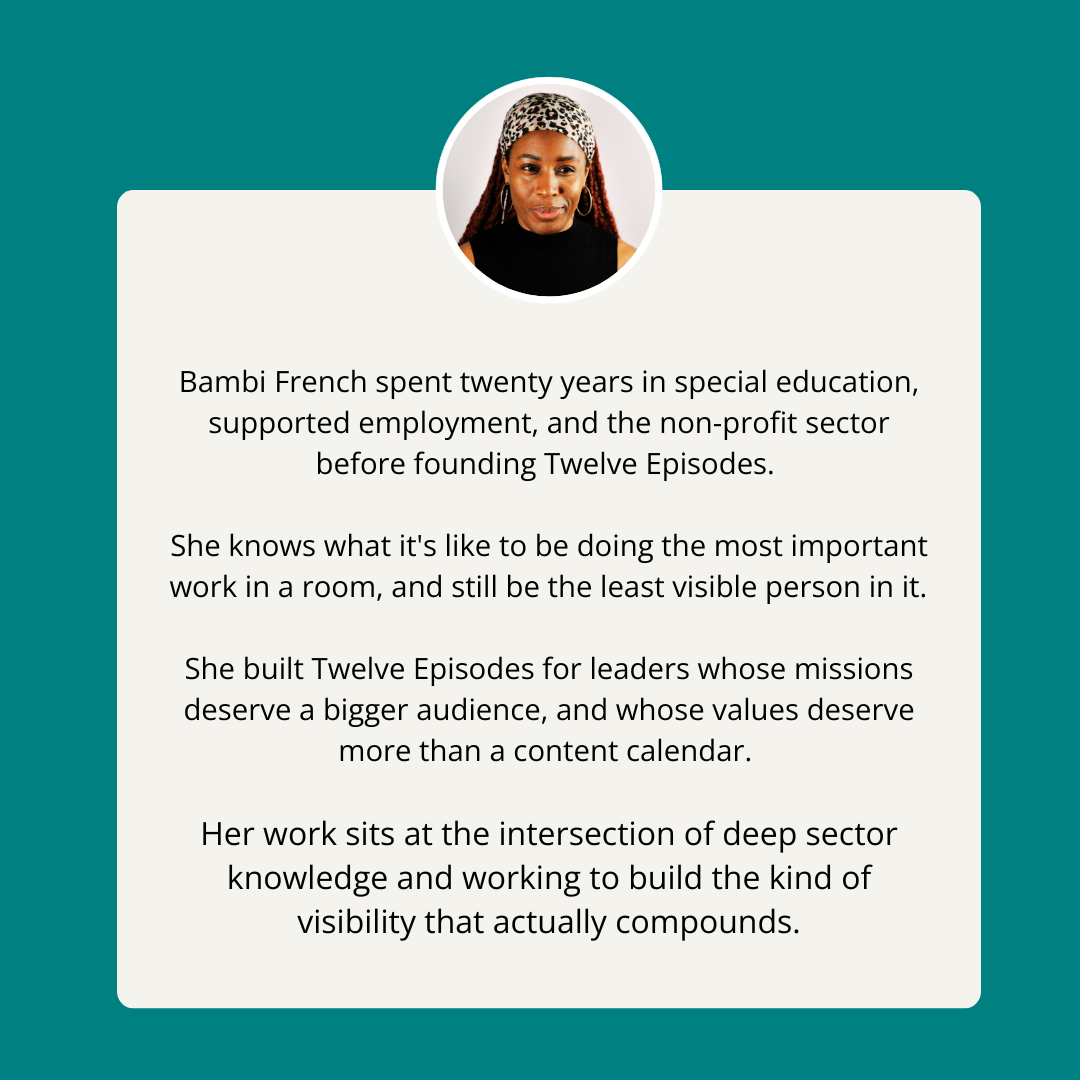
Twelve Episodes works with social entrepreneurs, charity directors, faith leaders, and non-profit founders to build strategic 12-episode podcast series that function as long-term visibility engines, not content treadmills.
If this resonated, the next step is simple.